

Habit Stacking: Attach New Habits to Old Ones
Most new habits fail for a simple reason. They have no clear place in the day. You decide to read more, stretch more, drink more water, or review your plan each evening, but you never decide exactly when you will do it. Without a clear trigger, the habit depends on memory and motivation, and both run out by the afternoon. Habit stacking fixes that problem by giving every new habit a home.
Habit stacking means attaching a new habit to a habit you already do without thinking. You brush your teeth every morning. You make coffee. You sit down at your desk. You lock the front door. Each of these routines can act as a trigger for the next small action. After I make coffee, I will drink a glass of water. After I sit down at my desk, I will write down my top three tasks. After I brush my teeth at night, I will lay out my clothes for tomorrow.
The method is small and quiet. It does not ask for a whole new routine or a big burst of willpower. It asks for one tiny addition to something that already happens every day. Over time, those tiny additions link together into a chain, and the chain becomes a routine you can trust. That is why habit stacking works so well for people who have tried and failed to build habits by effort alone.
What Is Habit Stacking?
Habit stacking is a way to build a new habit by linking it to a current habit. The current habit is the anchor. The new habit is the action you attach to it. The link is a simple sentence: after I do this, I will do that. The anchor gives you a reminder that is built into your day, so you do not need to remember the new habit on its own.
An anchor should be something you already do every day, at roughly the same time, in roughly the same place. Making coffee, brushing your teeth, starting your computer, eating lunch, and getting into bed are good anchors because they are steady. A habit you only do sometimes, like going to the gym or visiting a friend, is a weak anchor. It will not remind you often enough.
Why Habit Stacking Works
Habit stacking works because it uses a cue you already have. Most habits fail not because the action is hard, but because the reminder is missing. You forget to stretch because nothing in your day tells you to stretch. You forget to read because reading has no set time. When you link reading to your morning coffee, the coffee becomes the reminder. You do not need a separate alarm or a note on the fridge. The routine itself does the reminding.
It also works because it lowers the effort needed to start. A new habit on its own can feel like a big change. A new habit attached to an old one feels like a small change. You are already in the kitchen making coffee. Adding a glass of water takes only a few seconds. You are already sitting at your desk. Writing down three tasks takes only a minute. The small size makes it easy to say yes, even on a tired day.
The Habit Stacking Formula
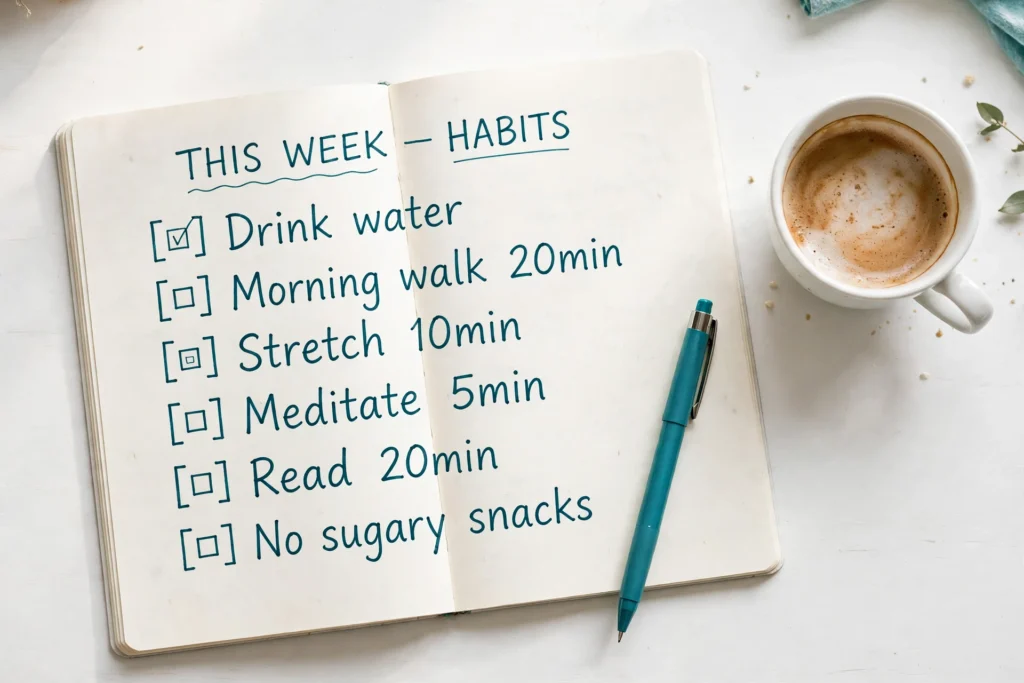
A good habit stack follows a simple formula: After I do this current habit, I will do this new habit, at this place and time. Writing it in that form makes the plan clear enough to follow without thinking.
Start with the anchor. Choose a current habit that is specific. “After I wake up” is vague, because waking up leads to many different actions. “After I brush my teeth in the morning” is specific. You know when it happens and where you are. “After I pour my morning coffee” is specific. “After I sit down at my desk with my laptop open” is specific. The more precise the anchor, the better it works as a trigger.
Habit Stacking Examples for Morning, Work, and Evening

Habit stacking is easiest to understand through examples. The best stacks are the ones that fit your own day, but these examples can help you see how the method works in different parts of the day.
In the morning, the anchors are strong because the routine is steady. After you make coffee, you could drink a glass of water. After you brush your teeth, you could do five stretches. After you get dressed, you could write down one thing you are looking forward to today. After you sit down for breakfast, you could read one page of a book. Morning stacks work well because they set the tone for the day before other demands arrive.
How to Build Your First Habit Stack

Building your first habit stack takes only a few minutes. The steps are simple, but doing them in order makes the stack much more likely to last.
First, list your current habits. Write down five or six things you do every day without thinking. Making coffee, brushing your teeth, eating lunch, starting your computer, locking the door, and getting into bed are common ones. Look for the habits that happen at the same time and in the same place each day. Those are your strongest anchors.
Common Mistakes That Break a Habit Stack

Habit stacking is simple, but a few common mistakes can break a stack before it has time to form. Knowing them helps you build a stronger stack from the start.
The first mistake is choosing a weak anchor. An anchor that only happens sometimes cannot remind you every day. “After I go to the gym” is weak if you only go twice a week. “After I finish a run” is weak if you run irregularly. Choose an anchor that happens daily, at a steady time, in a steady place. Daily routines are the best triggers.
How to Grow a Stack Once It Sticks
Once your first stack feels easy, you can grow it in small steps. Growth should be slow and steady, not a sudden jump. If you started with one page of reading, move to two pages. If you started with five stretches, move to ten. If you started with one line in a journal, move to three lines. A small increase is easy to keep, and it adds up over weeks.
You can also add a second action to the same anchor. After your morning coffee, you might drink a glass of water and then write down your top three tasks. After you brush your teeth at night, you might lay out your clothes and then set out your bag. Adding one action at a time keeps the chain manageable. If the chain starts to feel heavy, stop adding and let it settle.
Habit Stacking for Focus and Productivity
A work stack can help you start the day well. After you sit down at your desk, write down your three most important tasks. After you open your email, deal with only the urgent messages, then close it and start your first task. After you finish a meeting, write down the next step before you move on to the next thing. Each of these small actions reduces the need to decide in the moment, which saves your attention for the work itself.
Tips to Keep Your Habit Stack Going
A habit stack lasts when it is easy, visible, and forgiving. These tips help you keep it going through busy weeks and low-energy days.
Keep the new habit tiny for longer than you think you need to. Many people grow a habit too fast and then drop it. A tiny habit that you do every day is stronger than a large habit you do twice a week. Let the link become automatic before you make the action bigger.
Design your space to help the stack. Put the book beside your coffee cup. Put the water bottle beside your desk. Put the journal on your pillow. Put your running shoes by the door. When the tools for the new habit are already in place, the step from anchor to action is short. When they are hidden in a drawer, the step is longer and easier to skip.
Frequently Asked Questions
What is habit stacking?
Habit stacking is a method where you attach a new habit to a habit you already do every day. You use the current habit as a trigger, so the new habit has a clear time and place. The formula is: after I do this current habit, I will do this new habit.
How do I choose a good anchor habit?
Choose a habit you already do every day, at roughly the same time, in roughly the same place. Making coffee, brushing your teeth, sitting down at your desk, eating lunch, and getting into bed are strong anchors because they are steady and specific.
How small should the new habit be?
Start with something you can do in two minutes or less. Drink a glass of water, read one page, do five stretches, or write one line in a journal. A tiny habit is easy to start, and you can make it larger once the link feels natural.
How many habits can I stack at once?
Start with one new habit on one anchor. When that feels easy, you can add a second action to the same anchor or start a new stack in a different part of the day. Stacking too many habits at once makes the chain hard to keep.
What if I miss a day?
Missing one day does not break a habit. Just do the stack again the next day, as normal. If you miss often, the anchor may be weak or the new habit may be too large. Choose a steadier anchor or shrink the action, and try again.
How long does habit stacking take to work?
It varies from person to person and from habit to habit. Many people find that a small stack starts to feel natural after a few weeks of daily practice. Track it simply for two weeks, then keep going and notice when the new action starts to feel like a normal part of the routine.
Start With One Small Stack Today
Habit stacking does not ask you to change your whole life at once. It asks you to add one small action to something you already do. That is a change you can make today, without a new routine, a new tool, or a big burst of motivation.
Pick one anchor from your day. Pick one small habit you want to build. Write the stack down in the full sentence: after I do this, I will do that. Put the note where you will see it, and do the stack tomorrow morning. Then do it again the next day. After two weeks, look at your tracker and see how far a tiny daily step can take you.
Over time, one stack can become two, and two can become a daily system that supports your focus, your health, and your work. The habits you want do not need to wait for a perfect week or a fresh start. They need a clear trigger, a small first step, and a link to a routine you already trust.
Related Guides
- Timeboxing: Assign Every Hour a Job
- Time Tracking 101: Measured Gets Managed
- The 10-Minute Rule: Start Dreaded Tasks
- Eat the Frog: Do Your Hardest Task First
- The 3 MIT Method: Pick Three Most Important Tasks
- The 2-Minute Rule: Clear Small Tasks Instantly
- Plan a Productive Day in 10 Minutes
- End-of-Day Shutdown Checklist for Knowledge Workers